
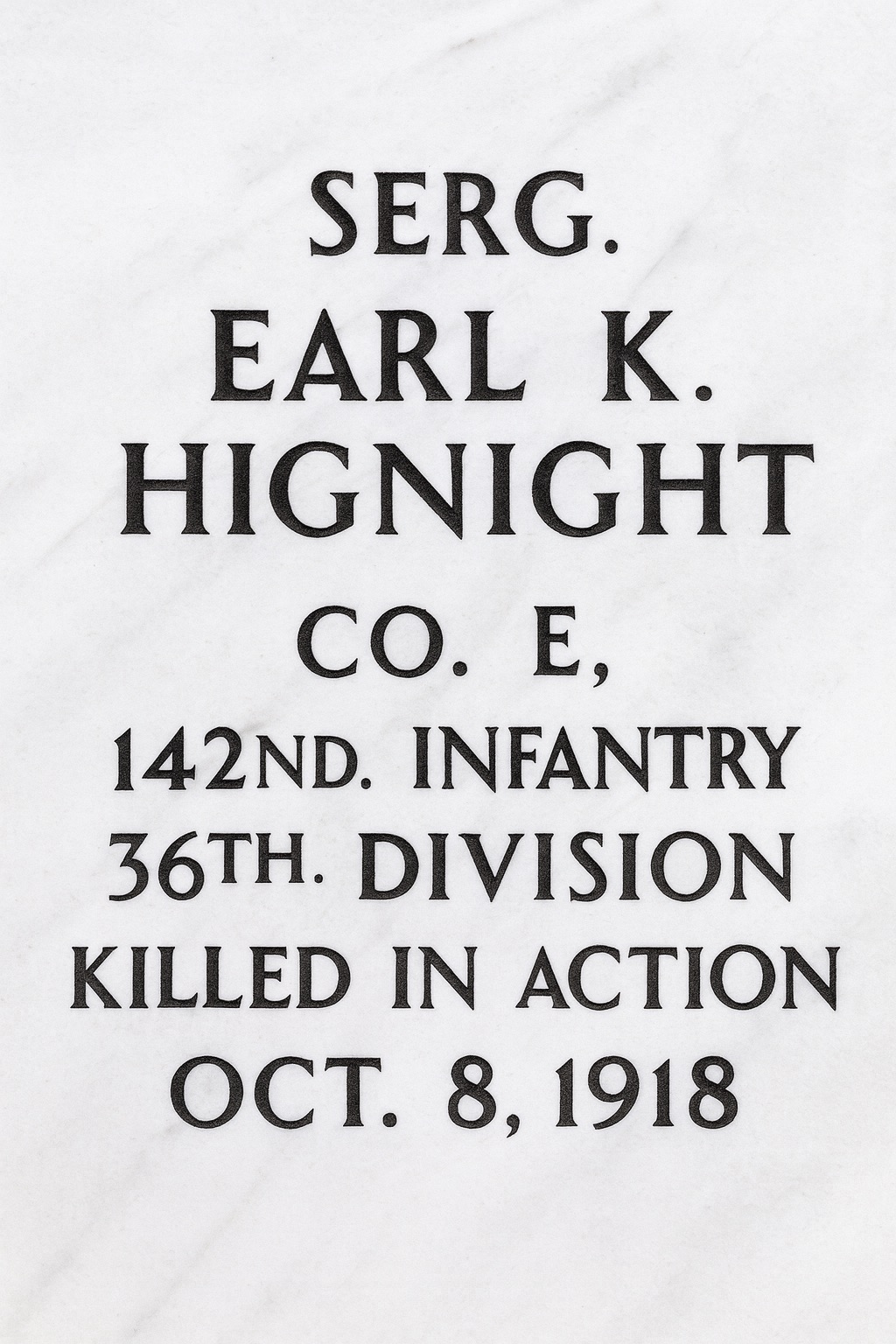
SGT. Earl K. Hignight
“He died on a day when Ardmore lost multiple sons in the same battle”
Sgt. Earl K. Hignight: A Life Given in the Fiercest Fighting of World War I
Some names come to us through the quiet permanence of carved stone, but behind each one is a life lived, a family left waiting, and a sacrifice that shaped the world we inherited.
Sergeant Earl K. Hignight is one of those names.
Sgt. Hignight served in Company E, 142nd Infantry, part of the 36th Division, a unit composed largely of young men from Oklahoma and Texas. In the fall of 1918, the 36th Division entered the Meuse‑Argonne Offensive — the largest and deadliest operation in American military history.
On October 8, 1918, Sgt. Hignight was killed in action.
That date appears again and again on Ardmore’s memorial stones. It was a day of devastating losses for the 36th Division, which had been thrown into the heart of the offensive. The terrain was brutal — dense forests, ravines, entrenched German positions — and the fighting was relentless. The division faced machine‑gun fire, artillery barrages, and the chaos of a battlefield that had already consumed thousands.
We don’t know Sgt. Hignight’s age.
We don’t know his letters home.
We don’t know the dreams he carried when he put on the uniform.
But we know this:
He fought in one of the most decisive battles of the Great War.
He served in a division that helped break the German line.
He died on a day when Ardmore lost multiple sons in the same battle.
His name, carved into stone more than a century ago, stands as a reminder that the cost of freedom is often paid by those whose stories history did not preserve. Fire Line honors Sgt. Hignight not for the details we lack, but for the courage he carried into the final, brutal push of World War I.