
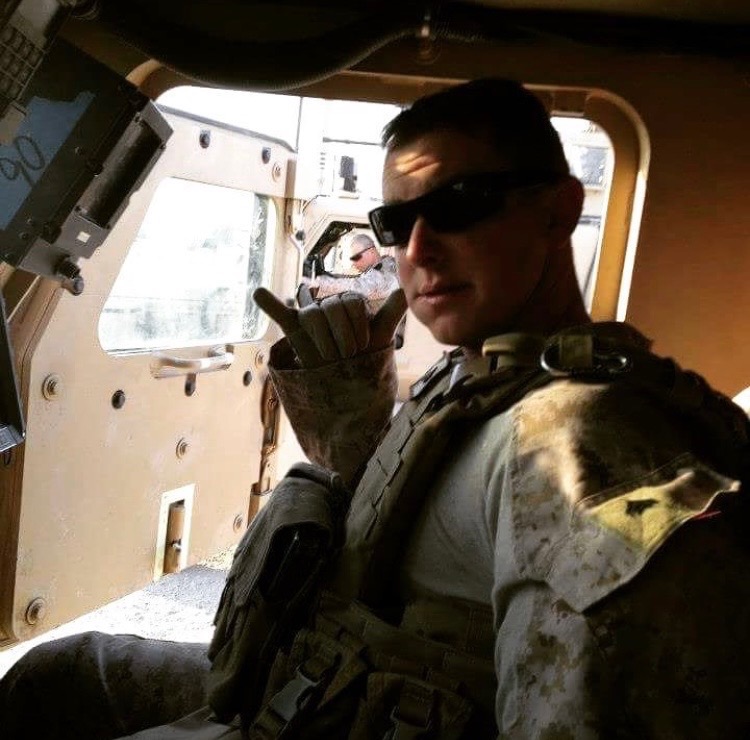
Trevor
The Weight, the Warrior, and the Human Beneath the Uniform
A Beginning That Chose Him
Trevor didn’t grow up planning to become a Marine. In his words, it was “a spontaneous decision,” sparked in a moment when a teacher told him to take the next opportunity that walked through the door — and a Marine recruiter literally appeared ten seconds later.
He shook the recruiter’s hand and stepped into a future no one in his family expected.
Growing up as “the black sheep,” he heard more predictions of prison or an early death than of success. The Marine Corps became his way out — and his way forward.
“Everyone told me I’d end up in prison or dead in a ditch. That was my line in to get it done.”
Becoming a Marine: Identity Forged Under Pressure
Trevor’s transformation began before boot camp, during weekly meetings with his recruiter. But the true shift — the one that changed his identity — happened in the crucible.
He describes it as being broken down, rebuilt, stripped of individuality, and reshaped into someone who understood loyalty, emotion, and responsibility.
“You go in a little boy and come out knowing emotion, knowing drive, knowing you’re looking after the guys to your left and right.”
For Trevor, being a Marine wasn’t a uniform. It was a way of existing in the world — everywhere, all the time.
Why He Chose the Hard Road
Despite scoring high on his ASVAB and being encouraged to pursue more technical jobs, Trevor chose infantry.
He wanted a legacy.
He wanted a story.
He wanted to be the one kicking in doors — the one he had admired in photos and videos growing up.
“I wanted to feel like I did something… I’d be the guy getting the bad guy.”
Discipline, Responsibility, and the Weight of Others’ Lives
Trevor’s discipline wasn’t natural — it was forged.
He learned quickly that if he failed, someone else could die.
“If I didn’t do my job, somebody would get hurt.”
The sleepless nights, the hunger, the repetition — all of it became part of his identity because others depended on him. Not just Marines, but soldiers, sailors, airmen, and civilians.
He trained so others could sleep.
The Psychological Reality: Anger as a Tool
Trevor speaks with rare honesty about the emotional and psychological conditioning of Marines. Many come from difficult pasts — and the Corps doesn’t erase that. It weaponizes it.
“They see that you’re angry and they reward you for your violence of action.”
In combat, that mindset is necessary.
In civilian life, it becomes a burden.
As a father — especially a girl dad — he had to unlearn the very traits that once kept him alive.
Combat: The Dream, the Reality, and the Aftermath
For Trevor, deploying as a Marine was “a dream come true,” something sacred — a moment he had trained and bled for.
But he’s honest about the truth:
-
80–90% of combat is boring
-
10–20% is chaos
-
The quiet moments are where doubt creeps in
-
“You don’t think about home. You think about the guys next to you. That’s all that matters.”
Combat changed him.
It taught him to live in the moment, to appreciate small joys — sunshine, a breath of air, even an extra chicken nugget.
Fear and Courage
Trevor dismantles the myth that Marines feel no fear.
“If you’re not scared, something is way wrong with you.”
Fear isn’t weakness — it’s awareness.
Courage is what you do with it.
Brotherhood Under Pressure
Trevor describes Marine bonds as something forged like diamonds — under years of pressure, pain, cold, hunger, and shared suffering.
“If me and him fight, that’s okay. But if someone else fights him, they’ve got hell to pay.”
The brotherhood extends beyond service.
It becomes family — wives, kids, barbecues, late‑night Walmart runs, all of it.
Leaving the Marines: The Scariest Transition
Trevor’s exit from the Marine Corps was abrupt — 30 days’ notice, no time to decompress, no time to plan.
He went from Marine to civilian to Army soldier in less than two weeks.
“I didn’t even have my boots off.”
The transition programs didn’t prepare him.
His job didn’t translate to civilian life.
He felt lost — so he reenlisted in a different branch.
Marine vs. Army: Two Cultures, Two Worlds
Trevor speaks candidly about the differences:
-
Marines: identity, aggression, small‑unit brotherhood
-
Army: larger, more structured, more resources, less personal
In the Marines, he was a necessary piece of the puzzle.
In the Army, he often felt like a replaceable number.
Yet his Marine training made him a strong leader — one who taught soldiers skills that later saved lives.
Dual Service Pride
Trevor served both branches as an NCO — something rare and deeply meaningful.
“It’s something to be proud of. Not many people can do it.”
What He Wants the World to Know
About service:
“It’s not a job. It’s a choice to volunteer — a commitment for a lifetime.”
About Marines:
“They’re human. They have feelings. They can love, they can be kind. They’re not robots. They’re not just violent. They’re human.”
 English
  Español
  Français
  简体中文
简体中文  Español de México
  日本語
日本語  Deutsch
  हिन्दी
  Português do Brasil
  한국어
한국어  Italiano
  עִבְרִית
  Русский