
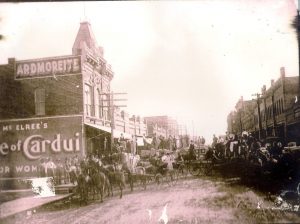
Ardmore in its early years, before the fires and rebuilding.
Long before Ardmore carried its name from Pennsylvania, this land belonged to the Chickasaw Nation — a people whose history, governance, and traditions shaped the region for generations. Families built ranch houses on the prairie, including the two‑room log home of Adam Jimmy, a Chickasaw rancher whose name marked the land southwest of town. By the time the Santa Fe Railway arrived in 1887, the Chickasaw presence was already deeply rooted here, and the new settlement grew at the crossroads of their homeland and the expanding railroad line.
Ardmore began in 1887, when the Santa Fe Railway laid its tracks across the Chickasaw Nation and a small settlement took shape along the line. The town was named for Ardmore, Pennsylvania — one of seven Oklahoma station stops that carried the names of Pennsylvania towns westward across Indian Territory.
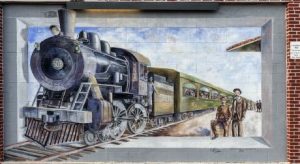
A Santa Fe steam engine locomotive at a regional depot, similar to the one that shaped early Ardmore.
Historical image courtesy of the Library of Congress
What started as a cattle‑loading point grew into a center of ranching, cotton, and later oil. Ardmore rebuilt itself after fire and explosion, each time shaped by the resilience of the people who called this place home.
This page honors that lineage — the land, the families, the workers, and the stories that formed the heart of Ardmore.
When the Santa Fe Railway laid its tracks across the Chickasaw Nation in 1887, the new settlement needed a name. Railroad officials chose “Ardmore,” borrowing it from Ardmore, Pennsylvania — one of seven Oklahoma station stops that carried Pennsylvania names westward across Indian Territory. The name traveled by rail, but the town that grew beneath it belonged to the people who worked the land, built the homes, and shaped the community that would become Ardmore.
In the years after the railroad named the town, Ardmore grew through the work of its people. Ranchers drove cattle across the prairie and loaded them onto the Santa Fe line. Cotton fields stretched across the countryside, shaping the rhythms of planting and harvest. Railroad workers kept the line moving, connecting Ardmore to markets across the territory. When oil was discovered, the town expanded again, drawing new families, new trades, and new possibilities. Ardmore’s early identity was built through labor — steady, physical, communal — the kind of work that bound neighbors together long before the trials that would test the town’s strength.
Ardmore’s early years were marked by fires that tested the town long before the disaster that would define it. The fire of 1895 swept through the downtown district, destroying wooden storefronts and forcing merchants and families to rebuild from the ground up. In the years that followed, smaller fires struck again and again, each one met with the same pattern of neighbors stepping in, businesses reopening, and the town refusing to lose its footing. These early trials forged a resilience that became part of Ardmore’s identity — a resilience that would be called upon in 1915, when an explosion shook the town with a force unlike anything it had faced before.
On September 27, 1915, Ardmore faced the greatest test in its early history. A railcar loaded with casinghead gasoline exploded near the Santa Fe depot, sending a shockwave through the downtown district and igniting fires that swept across the heart of the town. Dozens were killed, hundreds injured, and entire blocks were reduced to rubble. In the hours that followed, neighbors carried the wounded to safety, merchants opened their doors to shelter families, and workers from every trade joined the rescue efforts. The destruction was immense, but the response revealed the character Ardmore had been building for decades — a community shaped by work, tempered by earlier fires, and bound together by a resilience that refused to break
In the years after the explosion, Ardmore rebuilt once more, carrying forward the resilience that had shaped the town from its earliest days. From this community came the men whose stories are remembered here.
THE FIVE SONS OF ARDMORE
In the quiet heart of Ardmore, five young men stepped forward from the rhythms of work, family, and firelight to serve a country at war. They left behind the stone streets and cotton fields, the scent of pecan wood and the hum of freight trains — and they did not return.
This memorial gathers their names in one place, not as a list, but as a lineage. Each page preserves the shape of a life: the units they served in, the dates they fell, and the town that still carries their stories. Their stones, worn by weather and time, remain steady witnesses.
Together, they form a constellation of service and sacrifice — Ardmore’s offering to history, held with reverence and love.
Memorials (Coming soon)